The History of St John's Church
Explore the fascinating history of St Johns from the 1180 to present day gathered from numerous research sources conducted by members and associates of St John's & St Leonard's Church over time and collated by the Parish Administator in 2025.
Indulge in the detailed account from W Kuhlicke written in 1961, which traces the development of St John's from it's early medieval beginnings as a charitable hospital, with in-depth analysis of how the Master and Brethren administered the hospital's lands and income as well as it's governance and religious evolvement over the centuries. Gain insight into its architectural changes during reconstructions and restorations as well as Victorian expansions.
Furthermore, browse through our various collected archives showing St John's through time, our Church yard which closed in 1855 and some interesting newspaper citings from the 1900's.

A History of the Hospital and Parish Church of St. John the Baptist, Bedford...
The below account is extracted from the published book titled above, written by F. W. KUHLICKE, B.A., F.S.A. from 1961.
The parish of St. John Baptist, Bedford, was until recently a small island parish within the larger parish of St. Mary the Virgin. When the parish became a separate ecclesiastical unit is not known for the early history of the Hospital, the Church and the Parish is far from clear. It is situated partly within and partly without the King's Ditch, an ancient defence-work begun by Edward the Elder after he had expelled the Danes from Bedford in 910 A.D.
The difficulty about the date of foundation lies in the fact that there is no original charter extant and that a later copy contains an obvious error of date. In an ancient memorandum of Bishop Beaufort of Lincoln it is stated that " In the year 980 Robert de Parys was founder of the New Hospital of St. John Baptist in the town of Bedford." Herein lies the error of date. In two charters dated between 1170 and 1180 the name of Robert, priest of St. John Baptist, Bedford occurs among the witnesses and in 1202 among the common pleas of the Bedford Eyre there is a claim made by the Prior of Newnham against Robert de Parys.
Other references to the Hospital about this time refer to the Hospital but it is not clear whether de larys actually tounded or only re-founded it. Between 1180 and 1194 Simon de Beauchamp of Bedford granted the chapel of St. Thomas on Bedford Bridge to the Hospital which " Robertus de Parys fundavit." In 1272 Stephen le Mercer of Bedford granted to the Hospital of St. John Baptist two acres of land in Bedford," adjoining de Parys yard " and as the years went by it almost became a pious custom to give land and money to St. John's Hospital. It must, of course, be understood that the Hospital was not a hospital in our modern use of the word, it was a home of a small fraternity of poor men, rarely exceeding nine or ten, who eat in a common dining room, slept in a dormitory, wore a uniform habit and under the rule of a cleric who was the " Master " kept certain rules of worship and behaviour.
It is possible that Robert De Parys founded a new Hospital as distinct from an older foundation of the same name in another place. Certainly there are references to the " prior and canons " of St. John's in some records and to the "master and brethren " in others. Later the brethren were known as bedesmen or beadsmen and the master as rector. The chief rule that they had to obey was to keep silence in the church, the cloister and the dormitory," their " uniform and humble habit " was a black gown with a red maltese cross on it. (On a tombstone in the church may be seen a large cross of this type). The present rectory contains some of the old hospital, possibly the master's apartments, the refectory and dormitory but it has been frequently and considerably altered. The cloister, or that part of it which joined the Hospital to the church was in existence as late as 1760. No mention of the church as a parish church is to be found in the earlier deeds and as it was not taxed in 1291 by Pope Nicholas it is most likely that until the fourteenth century it was only the chapel of the Hospital. In 1321 however both the Hospital of St. John Baptist and the neighbouring leper hospital of St. Leonard are referred to in a document as parishes and thenceforth we get references to the " parochia hospitalis."
There is very scanty material available for both the Hospital and church during the Middle Ages apart from the names of the masters and the bequests of benefactors. The earliest recorded master after the founder is Baldwin appointed in 1286. In 1444 we get the first dated reference to the appointment of a Master by the Mayor of Bedford when John Thorpe was presented to the Bishop of Lincoln, to be in charge of the Hospital by reason of his seniority. This was the beginning of what became an established right of the Mayor and Burgesses to appoint the Master though how this was obtained we cannot tell. There was once some evidence of this right for when it was challenged during the reign of Elizabeth I a document, now lost, was produced as evidence in court. At that time William Franklin was appointed by the Mayor and Bailiffs to the Hospital or Parish Church or Office of Rector of St. John Baptist in Bedford."
In a survey made in 1546 it was stated that " the Hospital of S*, John in Bedford was founded by Robert de Parys to the intent to find a master and priest to sing and pray for the souls of the said Robert, Henry St. John and others which should hereafter be benefactors to the said Hospital. The church of the said Hospital is the parish church of itself and there belongeth to the same about 87 houseling people (1.e. communicants); the said master of the Hospital is the parson and serveth the cure there and there is none other to minister unto the parishioners at times of visitation but the said master and chaplain." The revenue of the Hospital about this time was just over 21 consisting mainly of small rents. Under Henry VIII it was subject to an enquiry and it being reported that it had ceased to function as a hospital it was sequestered in 1547 "for there is found never a poor person nor hath not been by the space of many years.
The lands and rents were granted, for life, to a William Staunton and upon his death Queen Elizabeth I made a grant of them to John Farnhan and his heirs. Ultimately by purchase the Hospital came into the hands of Edward Williams but by this time the Corporation of Bedford had awoken to the fact that it had lost by default its patronage of the Hospital and Church. It therefore sought and obtained a decree from the Court of Exchequer by which its rights in the Hospital were restored. This was the beginning of a
• long legal controversy between the Corporation and the family of Williams lasting up to the end of the eighteenth century.
Meanwhile we find very little information about the church itself. In 1333 the Master, Robert Rous was appointed to hear the confessions of all the subjects of the archdeacons of Bedford and Huntingdon. He was succeeded upon his death in 1349 by another member of the same family, William Rous. During the Rous period the church fabric fell into disrepair and had to be rebuilt. The brethren were too poor to meet the full cost of the restoration and were given a licence to beg. This rebuilding probably included the present chancel which is mainly late fourteenth century. The nave, or parts of it, were probably older. So much delapidation, followed by frequent " lathe and plaister" patchwork in the 17th century and such drastic " restoration" in the 19th that there is very little left of the original structure. We can still see a blocked fourteenth century doorway in the north wall of the chancel whilst the piscina and three fine sedilia in its south wall of about the same period are well worth examination. Part of the font and chancel-arch also belong to this period but the tower is late 15th century.
In 1502 John Stow alias Bowys bequeathed " to the building of the steeple." Although fairly well endowed the little community of St. John's does not seem to have spent much upon its church fabric. In 1578 it was reported to the archdeacon that "theyre churche is in decaye and other things besydes but they wyll repeer them without any further authority...The minister weareth not his surplice at the communion. The chancel is in danger by the fall of the timber." It is also evident, as we shall see from the church-wardens account-books which go back to 1615, that the church was constantly being patched so that one is not surprised that virtually it had to be rebuilt in the nineteenth century. The first entry in the churchwardens accounts is an important one though the parchment is so stained and torn we have had difficulty in deciphering some of the words.
It seems certain however that up to 1516 the tower contained at least three bells weighing altogether "four hundred three quarters and three and twenty pounds" (i.e. 4 cwt. 3 qr. 23 Ibs.). These were taken down and delivered to John Knight to be recast. From him the church received back three bells, the sire " weighing 1½ cwt. 15 lb., the " second " of 2 cwt. 1 qr. 22 lb. and the " third " of 3 cwt. 4 Ib. Another bell, the sanctus or " sance" bell does not seem to have been recast. All these bells remained in the tower in constant and energetic use until the end of the eighteenth century. They were a constant source of expense probably because of their vigorous ringing and the consequent repairs to wheels, ropes and baldricks. The churchwardens' accounts are among our main sources of historical material during the next two centuries. From them we learn in 1616 five shillings was paid " for mending the way by the bridge against the king's coming." This was the bridge over the King's Ditch near the old Rope Walk. 1616 was a year of urgent repairs and there occur sums of money spent on patching and mending walls, windows and roofs. A load of stone cost one shilling, the mason got a half-a-crown for " mending the wall " another man threepence less for mending the west window, a load of clay cost one and four and as much again for carriage.
The south window was also mended, they spent fourpence for " yirthing" (i.e. earthing) the path. The rector at this time was Andrew Dennys who had been vicar of St. Paul's where a fine monument with his bust was erected in the chancel by his nephew, Thomas Hillersden of Elstow. There is also a contemporary oil painting of him at St. John's. Unlike his predecessor Dennys wore the surplice for in 1616
" the surplet " " the casic" and the frieze were in use and the surplice was washed twice!
The accounts for the next few years are very similar," laid out for mending the church wall, lath and nayles and workman," lath, nails, clay, lime, boards and plaister were constantly paid for for mending until one wonders how much of the ancient fabric could have survived.
Other expenses also occur—viz, "for mending the herse, one pennye." " Honkers and hinges 7d." a purlin 16s. 2d., 21 spars 8s. 3d. Repairs were made to the roof in 1620 and 1621 when the accounts included " claie to mend the walls and other partikelars "! Thomas Knight seems to have been employed on most of the jobs. We learn too from these accounts what rents came in, what interest on bonds (they were quite usurious in the 17th century!) what was spent on bread and wine for the communion or " laied out " on such occasions as the bishop's and archdeacon's visitations and the beer money given to the ringers for ringing on special occasions.
The visitations were more frequent than now-a-days,
taking place at "Midsumer," " Easter," " Mitkelmorse " (i.e. Michaelmas) and occasionally in June. Communions were mainly at the great festivals, Christmas, Easter, Whitsun and Michaelmas.
Some of the money spent by the church-wardens went on good things to eat and drink which usually accompanied parochial business transactions, visitations and election of wardens or even settlement of accounts. Payments for beer for the bellingers give us an idea of the events that called for them. Apart from Christmas and the New Year there were ringings " for the King's cumming " and always on the fifth of November " for the gunpowder plot." The bells seem to have suffered from heavy treatment about 1625 and needed considerable repairs and towards the cost Thos. Hillersden gave Dennys ten shillings. They were ringing again "at the Queen's coming" (that was Henrietta Maria in 1628).
Although under the new Poor Laws the overseers of the poor were responsible for "casuals " we find that many in need called at St. John's and were not turned away. Curious it is to note how many Irish people called for help and on one occasion a few pence were given " to a Scotchman that came." This entry is immediately followed by " to another that came "! Obviously a recommendation had been passed on. In 1628 alone eight Irish received 3d. or 4d., but others were " a frenshe caller driven out of his contri for religon, two
"Centish travellars," " a travellar that came with a cartiffycate for losses on the sase " (i.e. seas, " John Skidmore who came with the counsels littars pattins (letters patent) for losses on the seas by the dunkirke" and " two poore men whose father lost fourteen hundred pound when taken at Dunkirk."
It seems to have been the responsibility of the parish clerk to "keep the bells and wash the linen surplice and table cloth." For these services he received eighteen pence in 1632. He tells us that in 1633 he gave 3d. to a company of "iershes peple " (i.e. Irish people!). A " poore man's box " was purchased for 6s. 8d. and cost 8d. to "fix." Laud was now in power so they laid out 33s. 3d. "for the surplis and making of it " and 8d. for " the table-cloth making " which the clerk had to keep clean. The inventory for that year shows that the church possessed besides a Bible and the " register books," Thomas Jewell's works, the Book of Homilies, the Book of Canons and the Prayer Book. Besides the surplice there were two table cloths, five linen " seat cloths," a pewter flagon and a silver cup with cover. The latter are still in use.
The steeple was repaired in 1634 and when the bishop came the bells were rung. They paid 10s. for " stuffing the pulpit" (this does not refer to sermons but lining it with material!) and in 1635, because they had not carried out Laud's instructions about rails for communion the churchwardens were fined. in the archdeacon's court and they had to lay out money " for making the raylles about the tabelle." In 1638 Anthony Rush became churchwarden. This was the beginning of a long connection between the Rush family and St. John's where many of them are buried. They remained here after the Bedford Church had been established in the atlairs of which they took a prominent part. hat year the font was repaired-the first time the font is men-tioned. The pulpit seems to have been istuffed, point at this time and subsequent to its being
" fringed," furnished with " basses" or straw kneelers and given new ironwork." Once again the wardens were fined, this time it was 2s. 6d. "for the church not being paynted." The work had to be done and cost £3 10s. Od. at the same time windows were mended and " the gallery pulled down." By 1642 coming religious changes began to cast their premonitory shadows.
Matthew Drawton and Edward Emmson became churchwardens and held unchallenged office for seven years. The seven years' accounts are more or less lumped together so we get but few details. The Master or Rector at this time was Theodore Crowley who had been appointed in 1633. The repairs to the church gates seem to be the only repairs carried out apart from small patchings but wine and bread for communion, especially at Christmas, Easter, Whitsun and Michaelmas continue to be purchased and smaller sums are frequently paid to "poore Irish folk, for making In 1645 is this very significant entry clean the church when the camp was heare." In 1648 they spent a penny on nails for repair work! The following year the wardens were Anthony Rush again and Lewis Harding. They spent very little, on repairs, and for the poor and the usual bread and wine. The royal tragedy of January, 1649 did not have immediate repercussions on St. John's.
The communions continued up to 1652 and it was not till 1651 that they paid the " paynter " two shillings for " wiping out the K's arms by order of the Justice." Theodore Crowley was sequestered in 1653. At his departure the church possessed "1 carpet, 1 holland table-cloth, 1 hood and tippet and several books." The chest and rayles were crossed out of the inventory which was signed by the Mayor, John Grewe, formerly a churchwarden of St. Paul's but now a shining light of the new body of nonconformists calling themselves the Bedford Church. The churchwardens, Rush and Clerk are summoned to appear before the next sessions to give an account of how they had disposed of the wood, stones and other materials of the decayed church. "Offal" wood (tables, nails, etc? was removed from the chancel and the seats were sold. Money was laid out on repairs to the bier and bells but apparently the latter remained dumb. The foundations of the walls had to be secured for which lime, clay and sand were bought. Anthony Rush bought some wood out of the church for 26s. 8d. and " the lining of the tippett " was sold for 2s. (A fur for Mrs. Rush?). The interesting feature of these years of sequestration is the continuance of functioning churchwardens and the annual election and drawing up of accounts at Easter although there was only one in the year Easter 1659 to Easter 1660.
In 1660 came the Restoration of monarchy and established church and the Bedford Church was turned out of St. John's. They had not left it in very good repair and Welbourne, the churchwarden had to get some immediate "mendings" done. The first things demanding attention were the bells which had been silent so long and bell-frames and bell wheels had to be got into working order. The first call for a ring was, however, not the restoration of the king but the success of another stage in the legal war between the Corporation and the Williams family. A claim by Mr. Williams had been quashed and the bells rang " when the Corporation had the verdict against Mr. Williams." This was a bit of a strain on the bells and beer had to be bought for the men who " set on the wheel " before the bells could once again ring out merrily both for " the King's proclayming" and " the fifth of November." It cost half a crown to get permission from the Quarter Sessions to raise money for repairing the church and three-pence each for 150 copies of the order. The repairs to the steeple and bells were carried out and the bells rang a special peal for Sergeant Keeling. He was not a military man but a lawyer and one who, as an ultra-royalist had been elected as a member of parliament for the county. Meanwhile, as we shall see later, the church was falling into ruin.
Now we must look back and see how the church was administered during the political troubles of the century.
Up to 1653 Crowley had been rector and master having come from St. Paul's in 1633. It was of frequent occurrence to pass from the large parish with a small income to the small parish with a large income. In 1653 Crowley was sequestered and his place was taken by John Gifford. As we have seen, the corporation claimed the right of presentation and the mayor at this time was William Faldo. Now in 1650 a Free Church had been founded in Bedford under the spiritual leadership of John Gifford and among the leading lights of this new church were the elder John Eston and John Grew, both of whom had been churchwardens of St. Pauls and were now in 1653 on the bench of aldermen of Bedford.
The council was indeed strongly nonconformist and so they appointed Gifford to the rectory of St. John's and the church was appropriated by the "Free Church " that now called itself the Church of Bedford. As we have seen the church-wardens, or at times, one churchwarden continued to function and, in his capacity as patron the mayor instead of the rector signed the accounts. Mr. Tibbutt has given, in the Appendix to this short history, an account of Gifford and his association with John Bunyan, so we can pass on to Gifford's successor. Gifford died in 1655 and in the September of that year the Corporation of Bedford agreed that " Mr. Hayes of Papworth bee presented," and the Mayor, John Crowley, was authorised to set the town seal to an instrument to that purpose. Willam Hayes was rector of Papworth St. Agnes and was not acceptable to the Bedford Church and they appealed to Cromwell.
The folllowing October, the Mayor now being Simon Becket, senior, denounced the allegation that the appointment of Hayes was " surreptitiously contrived." They appointed two agents to go to London to represent them at a hearing before " his Highness." They were unsuccessful, however, as Cromwell decided in favour of John Burton, a young and far from robust man subject to frequent recurrences of sickness. Under him the more or less unbroken records of the Bedford Church (later Bunyan Meeting) began to be written. By this time Bunyan had become closely associated with the church and with Burton he disputed with the Quakers in St. Paul's " Steeplehouse." Burton died in 1660, the year of the restoration of the monarchy and the return of St. John's to the Church of England.
Theodore Crowley, the sequestered rector returned and looked after the hospital and church until his death in
1662. His place was taken by Robert Guidott whom the Corporation appointed in October, 1662. He had been the minister of St. Paul's from the Restoration until the return of its sequestered vicar, John Bradshaw. Before going to St. Paul's he had been rector of Little Barford. He seems to have neglected the church rather sadly and in 1669 he was cited for delapidations of the rectory kitchen. At the same time it was reported that " the parish church is fallen down and hath been for the space of seven years last past." Guidott died in 1677 and was buried in St. Paul's. His successor was Joseph Arrowsmith who had succeeded William Hayes at Papworth and was chaplain to the Earl of Allesbury.
The churchwardens' accounts during this period are much like those before the Commonwealth. The bells seem to be rung more frequently-coronations and anniversaries of them, royal birthdays, May 29th (Oak Apple Day, St. George's Day and November 5th (" Gunpowder treason ") are fairly regular and then there are occasions when visitors of importance came. Such occasions as bishops' and archdeacons' visitations call for eating and drinking (a quart of sack 2/-) rent collecting and making up accounts needed "beer at Lawrence's. They had to pay 3s. 10d. when they were cited in 1662 for repairs.
The accounts between Easter, 1665 and Easter, 1669 are missing. During that period the church must have had some extensive repairs. We find the ringers receiving 1s. 6d. and a "treatment " costing 2s. Od. " at laying the foundation of the church." Subscriptions were being made towards the cost but even these cost money to collect. We do not know how much the Earl of Bedford gave but it cost the church-wardens 2s. 5}d. laid out as follows:—" Charges in a journey to Woburne: for a horseshoe 5d., oats 42d., hay and ostler 4d., beere and tobacco 1s. 4d." To collect the Earl of Bolingbroke's subscription from Melchborne it cost eightpence. One notices a remarkable rise in the price of laundry; whereas it used to cost sixpence to wash the rector's surplice the price is now four shillings— but that was for four years apparently.
The inventory of 1672 shows that nothing could have been removed from the church during the period of sequestration. There were still the copy of Jewell and Harding a new clasp had been added) a silver cup and cover, the book of Homilies, the pewter flagon, table cloths, carpet and cushion and a surplice. Still the fabric of the church was unsafe and John Knight and his man spent five days with timber, board, clay and sand mending the church wall. In 1673 they paid a man a penny! " for fetching things out of the church when the chancel fell." In 1677 " the walls in the church next the chancel " were taken down and glass was put in the windows from time to time. The politics of James It's reign are reflected in the accounts, at the beginning, in 1685 the bells were rung " when the King was proclaimed " and again "at the crounastion."
In the following autumn they rang " when Monmouth was taken," and in 1688, on July 1st "for joy of the Bishopes being freed." The coming of William III and Mary II is noted by a shilling being spent "for orders to pray for the King and Queen," "for ringers proclaiming the King and Queen " and again at "the King's and Queen's crownation." Similar ringings took place for Queen Anne's accession and corona-tion, at news of Prince Eugene's battle, "the Duke of Ormonde's taking the Spanish fleet " and the usual " Gunpowder " ringing in November. All these ringings seem to have been a strain on the bells and bellropes and repairs to these seem far more frequent than repairs to the fabric of the church.
In 1713 the Master and Rector Paul Faldo died and thereupon the Williams family in the person of George Williams entered upon the Hospital premises but was soon turned out and in 1714 the Rev. John Towersey was presented to the living. George Williams continued to fight his case but he died in 1740 and his son George carried on his struggle to get possession of the Hospital and the advowson of the church. Meanwhile Towersey had died and was succeeded by the Rev. William Bedford upon whose death in 1754 Williams made another offer to the Corporation-or rather to the Mayor and some of the Corporation by which he was able to intrude the Rev. Richard Carryer.
This intrusion was set aside in 1756 by Lord Hardwick and the Rev. H. Hinde was instituted having been properly presented by the Corporation and at long last a law suit began in the reign of Elizabeth I came to an end. During the final stages of the case it was stated that out of the rents of the Hospital's considerable estates ten poor men of Bedford called beadsmen received ninepence per week each. Hinde died in 1787 and was succeeded by the Rev. John Parker until his death in 1828 when the Rev. Philip Hunt, D.D. became rector. He had to face a fresh challenge from Ralph Hanks and Charles Bradley.
Their information filed in the Court of Chancery in 1832 proved to be based on wrong assertions and was dismissed with heavy costs but Hunt resigned in 1835 and the Rev. H. Pearse was appointed in his place.
It was in 1760 when Hinde was rector that the well-known antiquary, William Cole, visited Bedford and dined at St. John's Rectory with the Rector who was a friend of his. Cole describes the church as a poor shabby building both inside and out but he considered the house excellent with great conveniences of out-houses and gardens, and " a cloister running from the house to the chancel door."
The living was then worth £200 a year. He noticed the altar " standing on an eminence of one step, railed in at a great distance, all within the rails being paved with a hard plaister or fine mortar." In the window of the " ancient hall " of the rectory were stained glass coats of arms and a royal crown of Henry VIl's time. He saw, too, the pair of great portraits in oils, which still exist, portraying two Rectors, Andrew Dennis and Joseph Arrowsmith (1677-1689).
For the remaining years of the eighteenth century the history of St. John's is rather uneventful except for the fact that it became a fashionable place for weddings and the registers show numerous couples who had no domicile within the parish or even in Bedford. It was in 1789 that the bells to which we have made frequent reference, ceased to function and were removed from the tower. They had celebrated several historic events since the ringing for the seven bishops. They had proclaimed the accession of William and
Mary, William's success at the battle of the Boyne (1691) and " the good success the English had over the French by sea " (La Hogue, May, 1692). They " proclaimed " Queen Anne's accession, Marlborough's and Prince Eugene's various victories and the defeat of the Scottish '45 rebellion.
The last special ring was in 1761 for the coronation of George III.
In 1786 the bells, now five in number, were taken down by order of churchwarden Thomas White and sent to William Emmerton, clock-maker and bell-founder to be recast with the addition of new metal. Emmerton had taken over the bell-foundry at Wootton so long run by Thomas Russell who was also a clock-maker. The Star Inn now occupies the foundry site. Now White had taken the bells down without the vestry's consent and nothing was done about rehanging the bells until June 1st, 1789 when the vestry met to discuss the situation. Emmerton had recast them and, according to a local tradition they were " lying kicking about in the orchard." However the vestry decided they could not afford to pay for the recasting and that in any case the tower was not strong enough to carry the bells.
They compromised with Emmerton offering him £4 for one of the bells and leaving him with the other four upon his hands, if he would sell them it would cover the cost of " fixing " the new bell which was " fixed " in 1791 and any This bell ung in the tower from 1791 to 1826 when over violent ringing during an election caused it to crack. With generous help from the Duke of Bedford a new bell was purchased, cast by T. Mears in 1827 and it still rings for services. Writing in 1831 J. H. Matthiason says, " the church has within a few years been considerably improved in appearance" and "the whole range of buildings has been so completely restored and.
beautified." Of the church he says, the interior, though small, is neat, and has a gallery over the entrance." He adds, "The ancient hall of the hospital was large and lofty but this has lately been altered for the convenience of a residence, so that the effect is entirely lost."
At this time ninepence per week was being paid to ten " poor freemen " of Bedford and services were held in the church once every Sunday morning or afternoon, alternatively with St. Peter's. This was during the Rectorship of Dr. P. Hunt who held both livings. The Rev. H. Pearse was rector from 1835 to 1889 and during his long period of office the whole set up of the Hospital and church was reconstituted by Act of Parliament in 1881. Trustees of the property were appointed and the charity was separated from the church.
Out of the net income, however, were paid the rector's stipend and the charity donations and pensions. The Hospital remained as the official rectory or master's residence. Some of the land was sold and the money invested and on this land were laid out De Parys Avenue (hence the name) and Bedford Park. The advowson of the church passed into private ownership and then in 1923 to evangelical patrons, The Martyrs Memorial Trust. The fabric of the church underwent considerable reconstruction in 1869-1870 when the present curious chancel arch. was constructed. A little later the vestries were added and subsequently enlarged.
Apart from the earlier architectural features already described there is little of interest in the building. Among the monuments the ledger stone inscribed to the memory of a former rector, Paul Faldo, 1714 originally contained an earlier memorial to a Rector as is shown by the indent of a brass half-figure and the "cross patee" badge of the house. Other memorials commemorate Edward Bourne, Rector, and his wite, John Towersey, Rector, his wite and his son John, and two other rectors, William Bedford and Henry Hinde.


Above is the portrait currently displayed in the Church Vestry of Henry Pearse M.A. Rector of St John's from 1835 to 1889, of whom, was the last master of the Hospital. He built the East Wing of the Rectory in 1851.
Brief Church Building Timeline...
c1180 - Original Hospital founded.
c1200 - Chapel built (present Church origin)
Mid 1500s - Established as a place of worship and became recognised as St John the Baptist Church with Tower added around 1500.
1540's - Dissolution of the Monstaries under Henry VIII. Hospital is dissolved and remains use as a parish church for the local community.
1600-1700 - Many baptisms, weddings & burials occur.
1722 - First burial at St John's Churchyard.
1855 - Last burial at St John's Churchyard.
1890 - (The Parish Hall/Office) is erected by W.O Parker Ford (Rector)
1977 - The Parish of St Leonard's Church Bedford united with parish of St John the Baptist, now becoming known as St John's & St Leonard's Church, Bedford.
Today - The Church Survived two world wars without major damage, Current building in continuous use with Services every Sunday morning serving its congregation and wider communities. Remains as one of Bedford's significant historic emblems in relation to its rectory (now St John's Ambulance Training HQ) with John Bunyan & John Gifford.
The Closed Church yard...
Our Church yard closed in 1855, although many were burried to the north & south side of the Church as well as West of Nave of the Church. The first burial was recorded to be in 1722 and the last in 1855 when the Church yard was closed. There are around 100 estimated buried with around 75 plots, many buried with their children or spouse.
For more information on our Church yard, please contact Church Office or Bedford County Record Office.
St John's in 1837...

St John's in 1869-70...

An item within our Church History Archives is the above newspaper clipping, highlighting an old photopgraph from before the Churches restoration in 1869-70.
View of St John's Church Tower & Hall...

This image would have been taken prior to the placement of Rope Walk and the roundabout which now sits in place ahead of the Church & Parish Office & the reconstruction/expansion of St Johns Parish Office/Hall building
St John's Church in local newspapers in the 1900's...
Please click on individual images to view clear, enlarged version. Sources for original publications are listed to each article. Full articles can be read on britishnewspaperarchives.co.uk with a monthly or one time subscription.

Source: Bedfordshire Times & Independent; 1939

Source: Bedfordshire Times & Indepednent; Friday 21st April 1939.

Source: Bedford Record and Circular; Tuesday 30th October 1945.
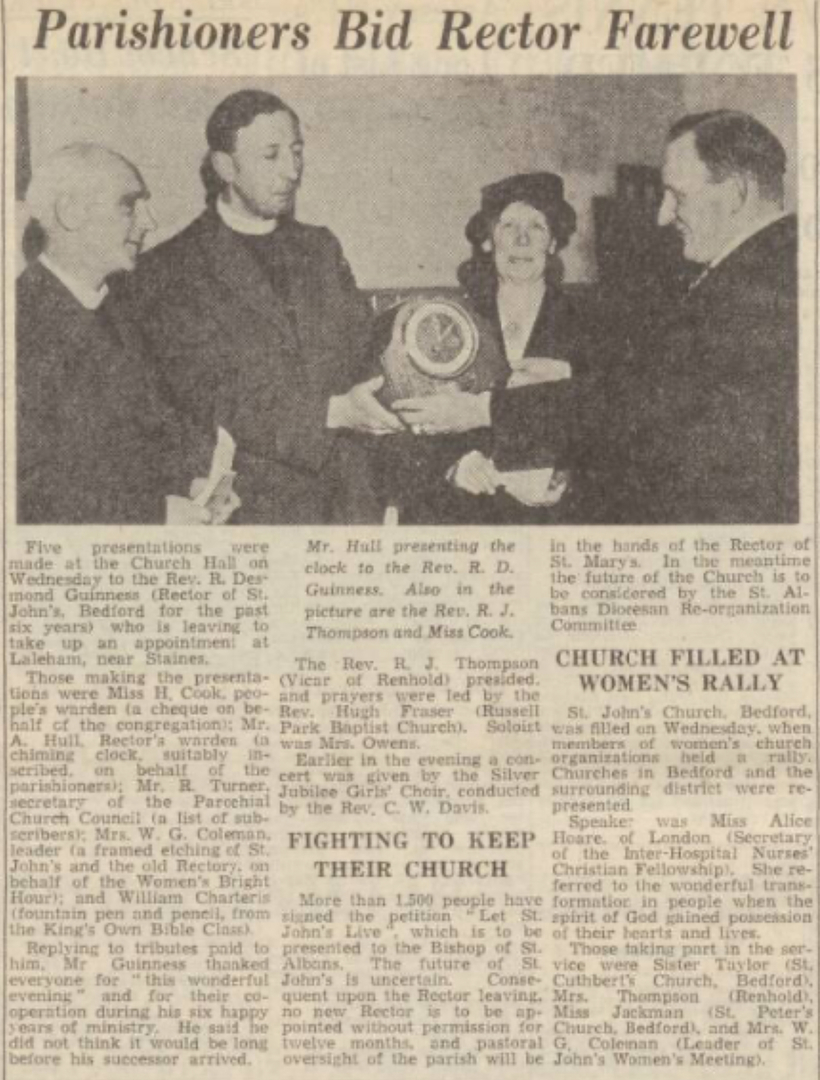
Source: Bedfordshire Times & Independent; Friday 16th May 1952.

Source: Bedfordshire Times & Independent; February 28th 1956

Source: Bedford Record, April 16th 1957.
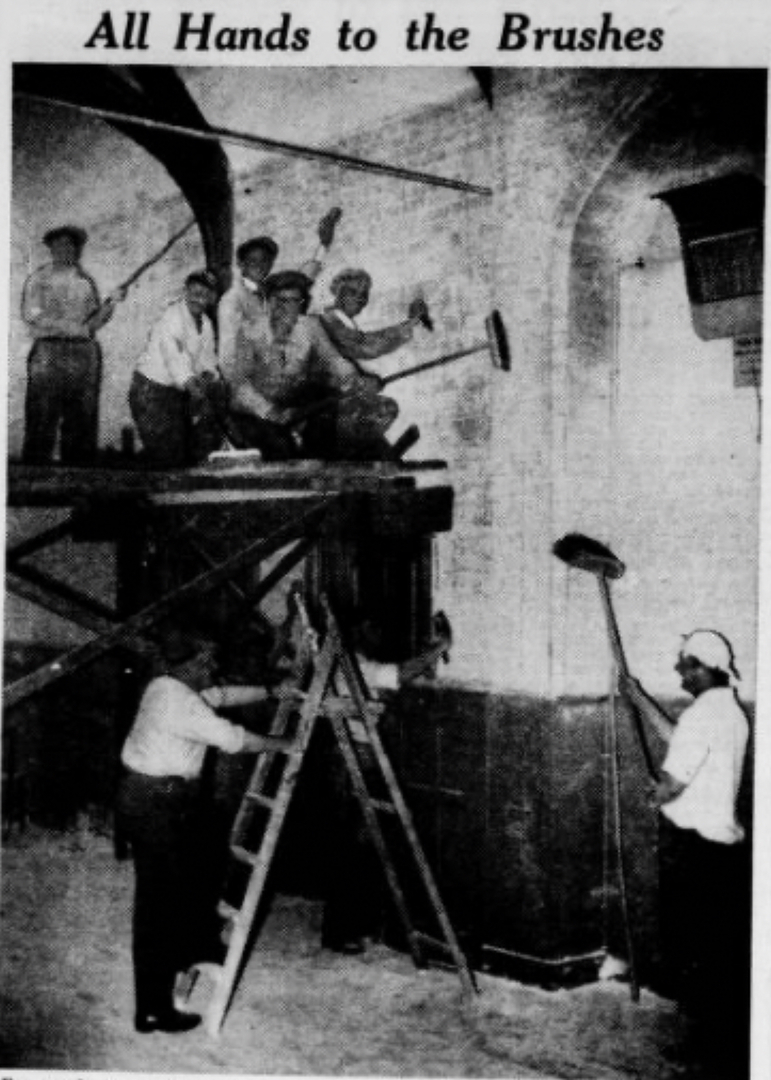
Source: Bedford Record Tuesday 12th August 1958. ''For two weeks now, men of St John's Church, Bedford, have been hard at work-voluntarily- cleaning down the Church halls and Kitchen prepatory to redcoration. Each night, Monday to Friday and average of 10 men from the Youth Fellowship and Church Officers has reported for duty wearing overalls for dirty work!

Source: Bedford Record and Circular; October 16th 1962.
Brief History Booklet...


The above booklet is part of our Church History Archives, presumably created as a form of income to the Church as sited cost of 5 pence, but also provide some brief understanding of the Church, John Gifford, John Bunyan & it's Architecture.
Tower Funding Leaflet...


Another item from our Church History Archives is the above Leaflet created and distributed when Rev. Michael Parker was rector from 1990-1999. The leaflet details various funding needed for repairs to our Tower, Hall & Church as well as renovations to St Leonard's Hall; Totalling at £115,609.
For more information on our Church Windows & Memorative plaques currently displayed as well as other images and information please visit the main History page on our Website or click button below:
Please contact the Church Office if you have any questions or suggestions for this page, all sources from this page can be shared if requested.

St John's
38 St John's Street
Bedford
MK42 0DL

St Leonard's Church Centre
Victoria Road
Bedford
MK42 9JS
The PCC of St John's & St Leonard's Church is a registered charity no. 1131545

 Print
Print 